
Layer Three: The Nervous System
Burnout doesn’t begin with workload. It begins with a nervous system that has been asked to stay “on” for too long. Not for a day. Not for a quarter. For years.
The Woman Who “Can Handle It”
Emma is a senior leader. A mother of two teenagers. The calm one in meetings. The steady one in crisis. The friend everyone calls. She doesn’t collapse. She adapts.
When pressure increases at work, she leans in. When her mother moves into aged care, she coordinates everything. When her husband is stretched, she absorbs even more at home. When a team member is struggling, she holds emotional space.
She tells herself: “I can handle it.” “This is just a busy season.” “I’ll rest when it settles.” But it never fully settles.
Over time, something shifts. She can’t switch off at night. Her sleep becomes lighter. Small requests feel disproportionately heavy. Her patience shortens. What she once absorbed now iritates. Her partner hasn’t changed. Her job hasn’t dramatically changed. She has. Not because she is failing but because her nervous system has been in sustained activation for too long.
High-Functioning Dysregulation
Burnout in capable women rarely looks dramatic. It begins quietly:
- Difficulty relaxing even when nothing is urgent
- Hyper-responsibility that feels automatic
- Emotional reactivity or emotional numbness
- A constant internal sense of pressure
- Rest that doesn’t restore
Women are often rewarded for nervous system over-functioning: Remaining composed under pressure. Holding complexity. Tracking emotional undercurrents. Managing relational risk. Staying “strong.” But composure without recovery becomes depletion.
The Nervous System Is Capacity Infrastructure
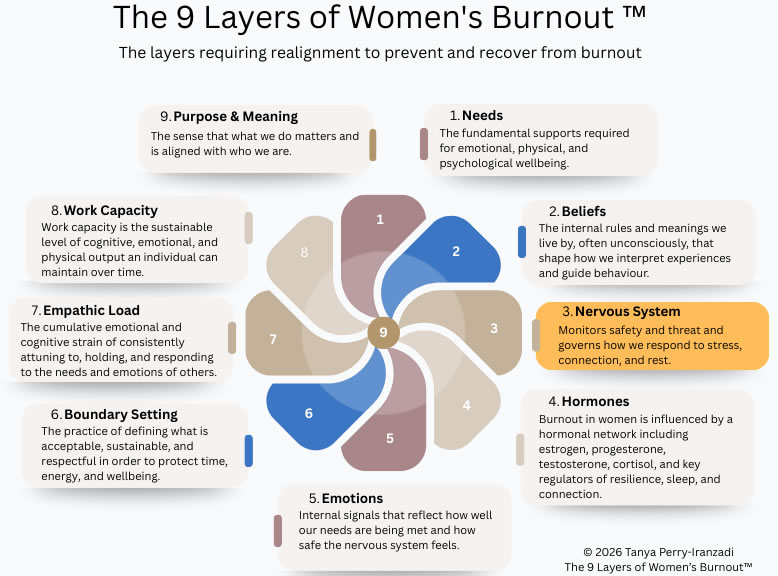
In The 9 Layers of Women’s Burnout™, the nervous system is foundational.
It determines:
- How much stress you can metabolise
- How clearly you think under pressure
- How confidently you hold boundaries
- How much empathic load you can absorb
- How much work capacity is genuinely available
When the nervous system is chronically activated: Beliefs become more threat-based. Boundaries feel harder to enforce. Hormonal resilience lowers. Emotions intensify or go offline. Work capacity shrinks. Purpose begins to feel heavy instead of meaningful. This is not a motivation issue. It is a regulation issue.
The Corporate Lens: This Is a Systems Risk
From a psychosocial risk perspective, chronic nervous system activation is not an individual weakness. It is an organisational exposure.
When high-performing women operate in prolonged hypervigilance:
- Decision quality deteriorates under invisible strain
- Retention risk increases long before resignation
- Conflict escalates at home and at work
- Emotional withdrawal reduces relational leadership capacity
- Succession pipelines quietly thin
Burnout does not remove women from leadership overnight. It erodes them slowly. By the time performance visibly drops, the nervous system has often been dysregulated for years. Resilience training cannot solve systemic nervous system overload.
Organisations must examine workload design, relational safety, decision transparency, and boundary norms. Most importantly organisations must introduce nervous system literacy. Because you cannot optimise output from a system operating in survival mode.
Why Rest Alone Doesn’t Fix It
Emma books a weekend away. She sleeps. She disconnects. She feels better. But within days of returning, the tension creeps back. Because burnout recovery requires more than time off. It requires understanding of the layers of Women’s Burnout.
And It requires nervous system literacy:
- Recognising early stress signals — not just symptoms
- Identifying bracing in the body
- Discharging stored activation safely
- Distinguishing urgency from conditioning
- Rebuilding internal safety
This is not indulgence. It is leadership longevity.
The War Women Fight… Within
Many women believe they are tired because they are not strong enough. The deeper truth is this: They are tired because they have been strong for too long without recovery.
The war women fight is not visible. It is the internal battle between capacity and expectation, between composure and exhaustion and between responsibility and regulation. The nervous system is often the first place this war shows up. And it is the first place we must listen.
Book Launch Announcement
Next week, I will be launching my book: The War Women Fight…Within
It is based on The 9 Layers of Women’s Burnout™ model and explores the invisible internal battles behind high-functioning burnout from needs and beliefs through nervous system regulation, emotions, hormones, boundary setting, empathic load, work capacity, and purpose.
This book is not about fixing women. It is about understanding the internal and external systems that quietly exhaust them and how to restore choice, capacity, and self-trust.
More details coming soon.
For now, pause and ask:
Where is my body doing more work than my life requires? Where am I bracing without realising it? What would safety not strength look like right now?
Burnout is not the collapse of a women. It is the consequence of strong women surviving systems too long without repair. And the nervous system is where the truth shows up.
Next Article in the Series
Layer 3: The Nervous System – Where the truth shows up
Layer Three: The Nervous System Burnout doesn’t begin with workload. It begins with a nervous system that has been asked to stay “on” for too long. Not for a day. Not for a quarter. For years. The Woman Who “Can...
Read More