
Burnout in women is not just psychological. It is biological and one of the most misunderstood layers is hormones. Not in the stereotypical “she’s hormonal” sense. But in the reality that hormones regulate energy, cognition, mood, resilience, and recovery.
When this layer shifts capacity directly reduces, and many high-performing women experience this shift in silence and shame. They don’t want the slurs and insults, “she’s a hot mess,” If I can just contain it and keep my credibility. Fortunately, the corporate world is shifting and we are becoming aware of the perimenopause and menopause but hormones are more than oestrogen and progesterone.
It’s Not Just Oestrogen and Progesterone
Hormonal health is rarely explained properly. Yes, oestrogen and progesterone matter but so are:
- Testosterone – supports motivation, drive, confidence, libido, and cognitive sharpness
- Cortisol – the primary stress hormone regulating alertness and survival response
- Serotonin – stabilises mood and emotional regulation
- Dopamine – fuels reward, motivation, and focus
- Oxytocin – influences bonding, empathy, and relational connection
- Melatonin – regulates sleep and recovery
Hormones operate as an ecosystem. When one shifts, others compensate. We need to know how we can support more of the hormones that help us to stabilise mood, bond, regulate sleep, mood and recovery and reduce Cortisol build up, while managing the stabilisation of oestrogen and progesterone.
During perimenopause, menopause, chronic stress, postpartum years, or prolonged overwork, that system can become dysregulated.
When chronic stress elevates cortisol for years, other hormones compensate. Sleep weakens, emotional tolerance narrows, recovery slows, emotional bonds and connection reduce, and motivation fluctuates.
This is often interpreted as:
“I’m not coping like I used to.” “I’ve lost my edge.” “Why does everything feel harder?” It may not be your capability changing. It may be biology shifting under sustained pressure.
The Cortisol Story We Don’t Talk About
Chronic workplace stress keeps cortisol elevated. When cortisol remains high for prolonged periods:
- Progesterone can drop
- Sleep becomes disrupted
- Blood sugar fluctuates
- Emotional regulation narrows
- Inflammation increases
Over time, women aren’t just “tired,” they are biologically depleted. Burnout isn’t always psychological first. Sometimes it is hormonal dysregulation driven by sustained stress exposure.
A Case Study: Sarah
Sarah is 47. Senior executive, married with two teenagers and two sets of ageing parents. For twenty years she was known for composure under pressure.
Then, gradually:
- Sleep became unreliable.
- Small issues triggered disproportionate irritation.
- Her tolerance for emotional labour at work shrank.
- Presentations required more preparation.
- She felt flat, then anxious, then exhausted.
- She couldn’t communicate as she used to, the words would not come.
She blamed herself, she doubled down, she told no one. Eventually she described it as, “I feel like I’m working twice as hard to be half as effective.”
What Sarah was experiencing wasn’t incompetence. It was the interaction between perimenopausal hormone shifts and chronic cortisol exposure. Once she understood that, the shame reduced and strategy replaced self-criticism. Hormone literacy restored self-trust.
The Misinformation That Keeps Women Silent
Many women fear even exploring hormonal support because of breast cancer concerns linked to HRT. Much of that fear stems from early 2000s interpretations of the Women’s Health Initiative study, where risk messaging was amplified without appropriate context around age, formulation, timing, and absolute risk. Recent research has also found untreated menopause symptoms can significantly affect cardiovascular health, bone density, cognition (brain functioning) by up to a third, and quality of life.
HRT is not for everyone. It requires medical guidance from a professional such as a gynaecologist as there are breakthroughs in this area with new age HRT options. But outdated fear has left many professional women unnecessarily suffering during peak leadership years. Hormone literacy is not about pushing treatment. It is about informed choice.
Why This Matters in Corporate Environments
Many women reach senior leadership in their 40s and 50s — exactly when hormonal transitions occur. Yet workplaces are structured around stable male hormonal patterns.
No one discusses:
- Fluctuating recovery capacity
- Sleep vulnerability
- Stress sensitivity during transition
- The impact of chronic cortisol exposure on resilience
So women compensate. They overprepare, overdeliver, mask symptoms and push harder.
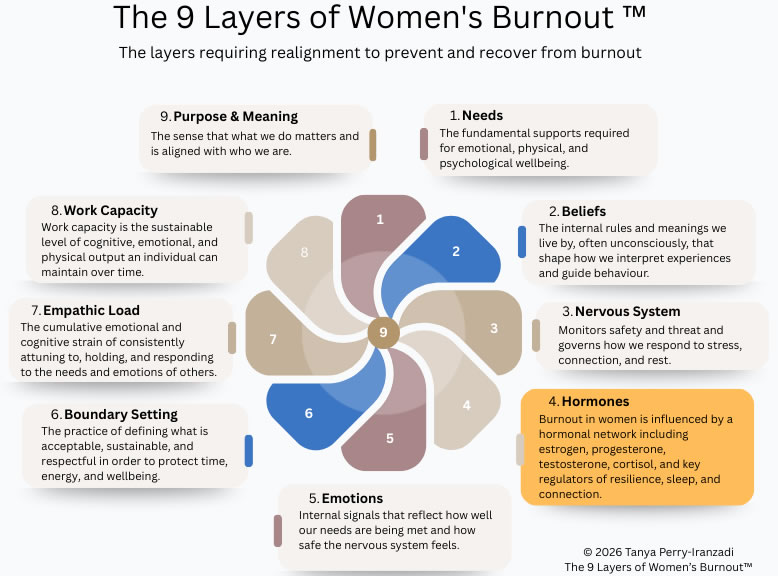
And Layer 4 amplifies every other layer of the 9 Layers of Women’s Burnout:
Needs – Rest and nourishment increase but are ignored.
Beliefs – “I must cope.”
Nervous System – Threat sensitivity rises, telling your system to brace and produce cortisol.
Emotions – become volatile and your ability to regulate diminishes impacting close relationships.
Boundaries – Energy drops, but expectations don’t.
Empathic Load – Emotional labour becomes heavier
Work Capacity – Output remains high while internal reserves shrink.
Purpose & Meaning – Questions intensify: “Is this worth it?”
You cope until something gives.
The Shift
Hormones are not a flaw, they are feedback. When understood, they become part of your self-leadership strategy, not something to hide.
We do not fix burnout by telling women to “be more resilient.” We restore burnout by understanding the system. Hormone literacy may be one of the most under-discussed leadership longevity strategies available to women today.
If you are a leader, HR professional, or executive reading this: How might your systems change if biological reality was acknowledged and educated instead of ignored?
And if you are a woman reading this: You are not losing your capability, your body may be asking for a different strategy.
In The War Women Fight…Within, I explore how these internal layers interact and why burnout is rarely about weakness, but about systems (internal and external) colliding and how to regulate your hormones.
If this layer resonates, it may not be because you’re failing. It may be because no one taught you how your biology works under pressure. And that changes everything.
Next week: Layer 5 — Emotions.
Follow along as we continue unpacking The 9 Layers of Women’s Burnout™.
The Book: The War Women Fight…Within launches this week.
This book names that war. It explains why burnout in women is not a motivation problem. It is not a resilience problem. It is not a confidence problem.
It is the interaction of nine internal layers: needs, beliefs, nervous system, hormones, emotions, boundaries, empathic load, work capacity, purpose and meaning, colliding with environments that were never designed with female biology in mind.
Next Article in the Series
Layer 4: Hormones – The Biology We Were Never Taught to Understand
Burnout in women is not just psychological. It is biological and one of the most misunderstood layers is hormones. Not in the stereotypical “she’s hormonal” sense. But in the reality that hormones regulate energy, cognition, mood, resilience, and recovery. When...
Read More