
Not as weakness. Not as overreaction. Not as something to “manage better.” But as data.
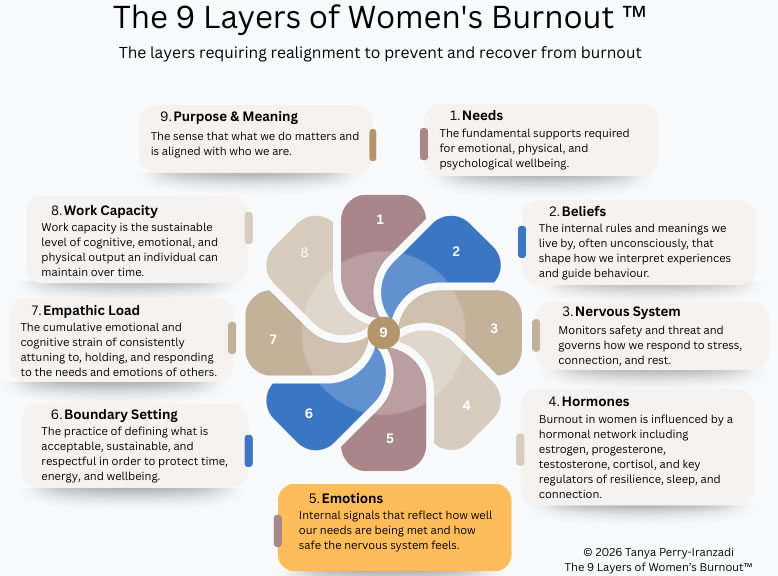
Emotions are internal signals. They reflect how well our needs are being met and how safe our nervous system feels. Burnout does not begin with exhaustion. It begins when emotional signals are repeatedly overridden.
- Frustration when boundaries are crossed.
- Resentment when contribution exceeds reciprocity.
- Anxiety when expectations are unclear.
- Numbness when capacity has been exceeded for too long.
When these signals are dismissed by culture, by leadership systems, or by our own belief clusters the body absorbs the cost.
Over time, women become highly skilled at emotional suppression: “I’m fine.” “It’s not a big deal.” “I can handle it.”
But suppressed emotion doesn’t disappear. It converts into muscle tension, irritability, into sleep disruption, into hormonal dysregulation, into reduced work capacity and into disengagement from self and others eventually leading to emotional numbness.
Emotions are not the problem. They are the early warning system. The question is not: “Why am I so emotional?” The question is: “What is this emotion signalling about my needs, my safety, or my boundaries?”
In high-performing women, burnout often hides inside composure. But composure is not the same as regulation. True regulation allows emotion to move and suppression stores it. If you are constantly “holding it together,” there is likely something underneath asking to be heard.
And when we learn to read emotion as information rather than identity we interrupt burnout at Layer 5, before it cascades into the deeper layers.
Layers 3, 4 & 5: The Nervous System, Hormones and Emotions What Women Get Blamed For
In the 9 Layers of Women’s Burnout™, layer 3 is the nervous system, layer 4 is hormones and layer 5 is emotions. These three layers are deeply interconnected. And this is where many women start to question themselves. “I’m more reactive lately.” “I cry more easily.” “My tolerance feels lower.” “I don’t feel as emotionally steady as I used to.”
Here’s what’s actually happening. Hormones don’t cause emotions. They influence the sensitivity of the nervous system.
Estrogen supports serotonin and dopamine regulation. Progesterone has a calming, GABA-supporting effect. Testosterone influences motivation and assertiveness. Cortisol mobilises us under pressure.
When estrogen declines (perimenopause), when progesterone fluctuates, or when cortisol remains chronically elevated from sustained stress, the nervous system becomes more sensitive to threat. And when the nervous system feels less safe, emotions amplify.
So what many women experience is not “poor regulation,” It is a biologically sensitised stress system layered on top of already high emotional load.
In corporate environments where: expectations are high, ambiguity is constant, caregiving responsibilities continue and boundaries are stretched, the hormonal layer and emotional layer begin to amplify one another.
Unprocessed emotion elevates cortisol and elevated cortisol disrupts sleep. Poor sleep further destabilises emotional regulation. Fluctuating hormones reduce stress tolerance. And the woman blames herself.
But this is not fragility. It is physiology interacting with environment. The goal is not emotional suppression. The goal is nervous system support.
When we: improve recovery rhythms, reduce chronic stress exposure, support hormonal health and build emotional literacy rather than override, we strengthen regulation capacity even during hormonal transition.
This is why burnout in women cannot be addressed at the workplace performance level alone.
It must include:
Layer 3 — nervous system capacity
Layer 4 — hormonal realities
Layer 5 — emotional signals
They are not separate; they are a system. And when women understand this, shame reduces, clarity increases and agency returns. This is the work, not fixing women, but restoring their internal feedback system, learning to trust themselves again.
In the book The War Women Fight…Within, I unpack the 9 interconnected layers of women’s burnout, from needs and belief clusters, to nervous system load, hormones, emotions, boundaries, empathic labour, work capacity, purpose and meaning. Because burnout isn’t a mindset issue, it isn’t a character flaw and it isn’t simply “hormones.” It’s a system.
When estrogen fluctuates, when cortisol stays elevated, when emotional signals are overridden, when boundaries erode and when belief clusters say “cope.” The war goes underground. Women don’t collapse loudly, they erode quietly.
This book is not about fixing women. It is about understanding the internal system and how it relates to our environment so clearly that shame dissolves and agency returns.
If you’ve ever thought: “I should be coping better.” “Why am I so reactive?” “Why am I exhausted when I’m still performing?” “Why doesn’t a holiday refresh me?”
This book was written for you.
The War Women Fight…Within — available now on Amazon.
What emotion have you been overriding lately?
Next Article in the Series
Layer 5: Emotions – The Signals We Were Taught to Ignore
Not as weakness. Not as overreaction. Not as something to “manage better.” But as data. Emotions are internal signals. They reflect how well our needs are being met and how safe our nervous system feels. Burnout does not begin with...
Read More