
A woman can be successful, capable, respected and still feel the quiet collapse of meaning underneath it all. She can keep performing, keep delivering, keep leading and keep carrying what others depend on and still find herself asking, often silently: What is the point of all this? This is one of the least understood layers of burnout.
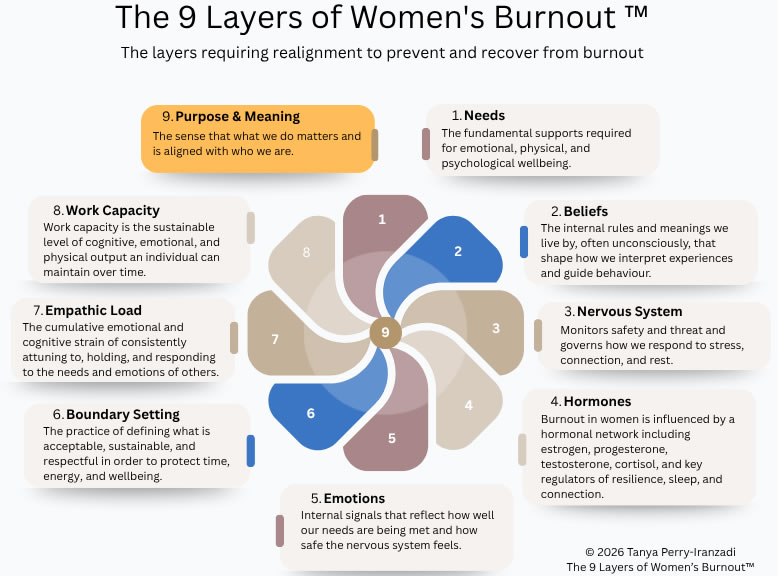
Burnout is not always loud. It is not always dramatic. It does not always look like breakdown. Sometimes it looks like a woman continuing to function in a life that no longer feels connected to her. In The 9 Layers of Women’s Burnout™, Purpose and Meaning is the sense that what we do matters and is aligned with who we are.
When that alignment is present, effort has direction. Even in hard seasons, there is a thread of coherence. What we are giving ourselves to feels meaningful. It fits. It resonates. It reflects something true and most importantly it refuels us, lights us up and satisfies a basic human need, my life matters, I matter.
When that alignment is absent, a woman can begin to feel she is spending her life force on things that no longer belong to her. That kind of depletion cuts deeper than tiredness. Much of the burnout conversation focuses on overload, pressure and exhaustion. These contribute and matter but they are not the whole story. The other side of the scales is what nourishes us and gives us joy.
Some women are not only burnt out because they are doing too much. They are burnt out because what they are doing no longer feels connected to who they are.
That disconnection can happen slowly. A woman adapts, she becomes responsible, she meets expectations, she performs, she keeps the system moving, she becomes who others need her to be, and somewhere along the way, she loses contact with herself. Not because she is weak or ungrateful, but because many women have been conditioned to prioritise usefulness over their own truth.
So they stay loyal to roles, structures, expectations and identities long after those things have ceased to feel meaningful.
The Hidden Cost of Misalignment
There is a particular kind of exhaustion that comes from living out of alignment. It is the exhaustion of saying yes when your deeper self says no. Of achieving what looked right on paper but feels empty in the body. Of meeting every obligation while becoming increasingly disconnected from your own inner life.
This is where women often say:“I should be happy, but I’m not.” “I’ve worked so hard to get here, but it doesn’t feel how I thought it would.” “I’m still functioning, but I feel flat.” “I don’t know what I want anymore.” “I feel like I’ve lost myself.” These are not signs of failure. They are signs that something essential is asking to be heard.
Purpose and meaning are not abstract ideas. They are deeply regulating forces. They shape motivation, resilience, discernment and vitality. They influence what we can sustain and why. When what we do matters, energy flows differently. When what we do is misaligned, even success can feel depleting.
Why Women Are Especially Vulnerable to This Layer
Women are often socialised to be relationally responsible. To notice needs, accommodate others, maintain harmony and carry emotional and practical load without complaint. These capacities are valuable. But they can come at a cost.
Over time, women can become so practised at responding to what is needed around them that they lose touch with what is meaningful to them. Not what is expected, not what is rewarded, not what proves their worth, but what is actually aligned with who they are. This is one of the most painful realities in women’s burnout.
A woman can build a life that looks successful from the outside and still feel internally estranged from it. She can be deeply needed and deeply disconnected at the same time.
Purpose Is Not a Luxury
Purpose is often spoken about as though it belongs to the privileged. As though it is a nice idea to explore once everything else is taken care of. In burnout work, purpose is not a luxury. It is a protective factor. It helps a woman organise her energy, it strengthens discernment, supports boundaries, makes sacrifice intelligible, helps you know what is yours to carry and what is not.
Without a sense that what we do matters and is aligned with who we are, effort becomes mechanical. Life becomes performative. Responsibility becomes increasingly empty. That is why women can be highly productive and deeply depleted at the same time.
Purpose Is Not Always Grand
This layer is also misunderstood because purpose is often framed as something dramatic such as a calling, a mission or a singular destiny, but purpose is often quieter than that.
It may be found in meaningful leadership, in advocacy, in healing, in creativity, in contribution, in mothering with consciousness, in building something honest, in living more truthfully and in choosing a life that fits.
Meaning is not always about doing more. Sometimes it is about doing differently. Sometimes it is about no longer betraying yourself in order to belong, succeed or be approved of.
Reclaiming Meaning Can Be Confronting
To reconnect with purpose is often to confront where we have abandoned ourselves and that can bring grief. Grief for the years spent performing, grief for the self that was silenced, grief for the dreams adapted downward, grief for the roles carried too long and grief for the cost of being who everyone needed. That is why this layer matters so much.
Because burnout recovery is not simply about getting energy back so a woman can resume the same life that depleted her. It is also about asking whether the life itself is aligned. Whether what she is pouring herself into is true, whether it matters, whether it reflects who she is now.
The Final Layer
This final layer brings the model to its deepest question. Not only: What is exhausting me? But also: What is my life force being given to?
Purpose and Meaning is the sense that what we do matters and is aligned with who we are. When that is missing, even high achievement can feel empty. When that is present, effort becomes more coherent, more intentional and more sustainable.
Women do not only burn out from pressure. Many burn out from prolonged disconnection from what is true. And recovery is not only about rest. It is about reconnection to truth, to self, to values, to meaning and to a life that fits.
Because the deepest form of burnout recovery is not simply returning to function. It is returning to what matters.
Final thought We will not solve women’s burnout by asking women to keep adapting to leadership systems that were never designed with sustainability, complexity or human capacity in mind. The next conversation has to be about leadership itself, how we define it, how we develop it, not only for performance, but for sustainability, innovation and longevity.
Beyond Extractive Leadership
A New 14-part series on The Integrated Feminine Leadership Model™
Once we understand burnout, the next question is: What is it about the leadership system itself that keeps producing it?
Starting 15 April, I’ll be launching a new 14-part LinkedIn series on The Integrated Feminine Leadership Model™. It is a shift from: “I understand my burnout” to “I understand the system I’m operating in.”
We have normalised a form of leadership that extracts from people faster than it renews them. Pressure, fear of losing your job, overextension, emotional compression, output at any cost. That is not sustainable leadership. It is extractive leadership.
This series explores what the old model has cost us, why it is no longer a fit for the world ahead of us, and what leadership must now become.
- From burnout as a design failure,
- The rise of AI,
- The capacities legacy models have undervalued,
- The future – a more integrated leadership architecture for sustainability, innovation and leadership longevity.
People are not machines, burnout is not the price of ambition and the future cannot be led well through the old model of extraction. The first post goes live 15 April.
The old model extracts. The next model integrates.
Next Article in the Series

Part 2: The Leadership Model We Inherited
Last week, I wrote about burnout as more than a personal experience. Burnout is also a leadership system failure, which raises the next question: What kind of leadership model have we inherited that keeps producing these outcomes at scale? Burnout...
Read More