
There is a form of work many women perform every day that rarely appears in job descriptions. It is not technical work. It is not strategic work. And it is almost never recognised as labour. It is empathic work.
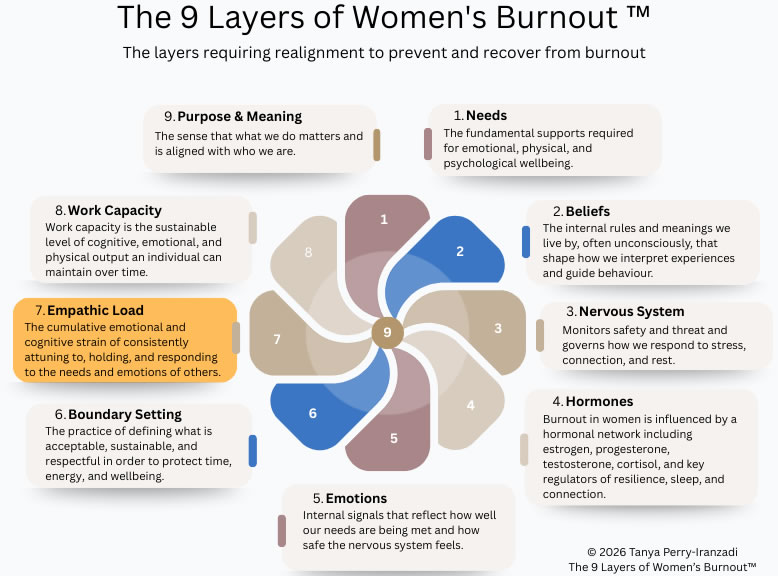
Empathic load is the cumulative emotional and cognitive strain of constantly attuning to, holding, and responding to the needs and emotions of others. For many women in leadership, this layer becomes one of the most invisible drivers of burnout. Because empathy is not simply a personality trait. It is energy expenditure.
What Empathic Load Looks Like
Empathic load builds quietly over time. It is present when you are:
- sensing tension in the room before anyone speaks
- adjusting your communication so others feel comfortable
- mediating conflict between colleagues
- supporting team members through personal crises
- reading the undercurrents of workplace culture
- the emotional shock absorber in communicating leadership decisions and change
- managing the emotional reactions of stakeholders
- carrying the emotional tone of meetings and decisions
Many women develop a remarkable ability to read people and environments. But the cost of constantly scanning the emotional environment is rarely acknowledged or even a conscious ability for the female leader as it’s not recognised as a skill or something of value.
Your brain is processing not only the task at hand, but the emotional climate surrounding it. That requires cognitive bandwidth. And over time, it becomes heavy.
A Story You May Recognise
Several years ago I worked with a senior leader who managed a large operational team. On paper, she was performing exceptionally well. Her results were strong, her team engagement scores were high. Her leaders described her as “the person everyone goes to when things are difficult.”
Yet privately she told me something different. “I feel like I’m holding everyone.” When someone in the team was struggling, they came to her. When two leaders were in conflict, she mediated it. When a project was failing, she absorbed the stress of the team and supported them. She said something that stayed with me. “I’m not just doing my job. I’m carrying the emotional weather of the entire department.”
Eventually she began experiencing classic burnout signals:
- exhaustion despite adequate sleep
- reduced cognitive clarity
- irritability she couldn’t explain
- a growing desire to withdraw
Nothing in her workload had technically increased. But her empathic load had. And it had quietly exceeded her recovery capacity.
Why Women Carry Higher Empathic Load
Many women are socialised from an early age to be emotionally attuned. To notice when someone is upset, to smooth conflict, to maintain harmony and to support others.
These skills are essential in the family unit and enormously valuable in leadership. They build trust, psychological safety, and team cohesion. But when empathy becomes unbounded responsibility for everyone else’s emotional state, the load becomes unsustainable.
Women are also more likely to be drawn into, and represented within, caring professions and roles where empathy is not just beneficial, but expected. Healthcare, education, human resources, and service-based leadership all rely heavily on emotional attunement. Yet the cost of this work is rarely acknowledged. Empathy is treated as a natural trait rather than a skilled form of labour, and because it is assumed rather than recognised, it is often unmeasured, unsupported, and left to accumulate over time with no training on how to contain it.
In organisational environments where leaders are expected to deliver performance and emotional stability for teams under pressure, the strain multiplies. The result is not lack of capability. It is over-extension of empathic capacity.
Empathy is often treated as a natural trait in women, when in reality it is a highly skilled form of labour that carries a very real, and often unacknowledged, cost. It is frequently assumed rather than recognised, which means one of the most critical leadership capabilities remains unmeasured, unsupported, and unaccounted for in workload design. This is a critical skill required in creating psychologically safe work environments, it is timely for organisations to assess this skill.
The Leadership Reframe
Healthy empathy is not about absorbing everyone else’s emotions. It is about responding without carrying.
Sustainable leaders learn to:
- support without over-identifying
- care without taking ownership of every problem
- listen without absorbing the emotional weight of every story
- create team capability rather than becoming the emotional container for everyone
Empathy remains a leadership strength. But it must be paired with boundaries and shared responsibility. Empathic capacity is a natural ability for most women leaders, the first step is to be conscious of how you are using your empathy and then learn how to contain it.
The Deeper Question
When women begin to recognise empathic load, they often realise something important: They were not only doing the work. They were holding the emotional system around the work. Once this becomes visible, leaders can begin redistributing that load in healthier ways. Because empathy should strengthen leadership. Not slowly exhaust it.
Closing Reflection
Burnout is rarely caused by one dramatic event. More often, it develops through layers of invisible strain. Empathic load is one of those layers. Quiet, unmeasured, but deeply influential. And when women finally understand it, many experience a profound shift: They stop asking “Why am I so exhausted?” and start recognising the weight they have been carrying all along.
Coming Next: Layer 8 — Work Capacity
Understanding empathic load often leads to a deeper realisation. Many women are not only doing the work. They are carrying the emotional system around the work.
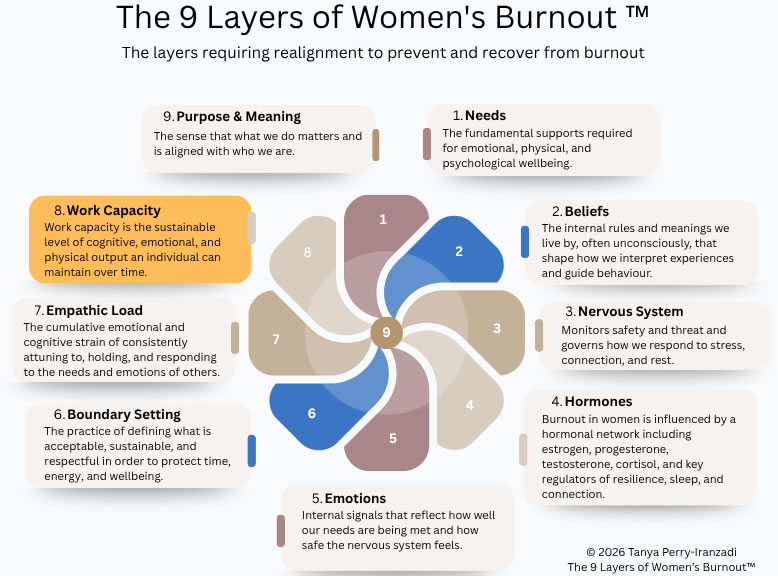
Over time, that invisible load quietly reduces work capacity, the sustainable level of output our bodies, minds, and nervous systems can maintain over time.
Next week in the series we explore Layer 8: Work Capacity why burnout is not a failure of resilience, but a mismatch between demand, recovery, and human limits.
This layer is explored in greater depth in my book The War Women Fight…Within, where the full The 9 Layers of Women’s Burnout model explains how these invisible layers accumulate and how women can interrupt and stop the burnout cycle.
The moment women recognise empathic load is often the moment they realise they were never just doing the work they were carrying the emotional system around it.
Next Article in the Series
Layer 8: Work Capacity – When Capacity Erosion Becomes a Financial Security Issue
The Career Cost of Ignoring Women’s Work Capacity Across Midlife One of the most expensive mistakes in women’s careers is the belief that work capacity is fixed, endless, or irrelevant so long as performance still looks intact. It is not....
Read More