
The Career Cost of Ignoring Women’s Work Capacity Across Midlife
One of the most expensive mistakes in women’s careers is the belief that work capacity is fixed, endless, or irrelevant so long as performance still looks intact. It is not. For many women, the cost of ignoring this becomes visible in the exact years they should be consolidating leadership, income, influence, and financial security.
We talk constantly about getting women into professional careers and into leadership. We talk far less about what keeps them there. The truth is this: women do not only leave leadership because of ambition gaps, confidence gaps, or pipeline problems. Many leave because their sustainable work capacity has been eroded by years of unmanaged demand across interrelating systems that were never properly understood and managed by them or supported by organisations.
That is not a personal weakness. This is a systems and work design failure and the result is a career longevity failure.
Women’s Work Capacity Is Not a Side Issue
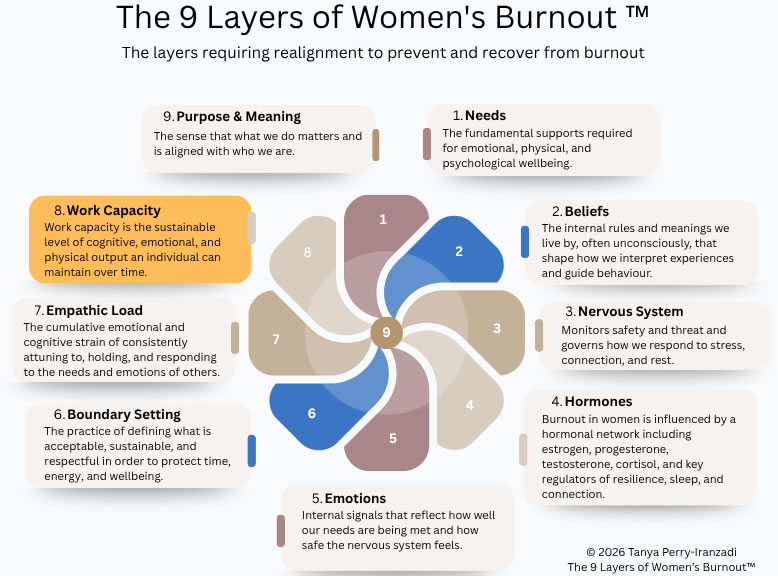
When I speak about work capacity, I am not referring to whether a woman is competent, committed, or capable of delivering at work. I am referring to the sustainable level of cognitive, emotional, physical, hormonal, and relational output she can maintain over time without destroying her health, her quality of life, her earning capacity, or her ability to remain in work and in leadership. That distinction matters. Women are still working inside systems that measure output but ignore cost.
If she is still delivering, she is assumed to be fine. If she is still leading, she is assumed to be coping. If she is still achieving, no one asks what it is taking.
Output is not the same as sustainability and women have become exceptionally skilled at performing capability while absorbing a private level of depletion that would concern us far earlier if we knew how to read it.
By Menopause, the Bill Arrives
For many women, the impact becomes impossible to ignore in menopause. Not because menopause makes women incapable but because it exposes what was already unsustainable.
The woman who has spent decades pushing through poor recovery, emotional strain, boundary failure, chronic over-responsibility, family load, leadership pressure, nervous system dysregulation, and hormonal disruption often reaches midlife with far less reserve than anyone realises.
Then the symptoms intensify. Sleep becomes less reliable. Cognitive sharpness is harder to access. Stress tolerance narrows. Recovery takes longer. Emotional load feels heavier. The effort required to sustain the same level of leadership becomes significantly greater. Then suddenly a woman in her late 40s or 50s begins wondering whether she can keep doing the job she worked twenty years to reach.
That should alarm us, because those are not the years when women should be quietly exiting influence. Those are the years when they should be consolidating it. Instead, many women begin scaling back, opting out, or questioning their future in senior roles at exactly the point where their earning capacity should be strongest. Once that happens, the loss is not just professional. It is financial. It can also be a loss of self-esteem.
This Is Not Just Burnout. It Is Lost Wealth and Lost Health
When women’s work capacity erodes at midlife, the consequences do not end with fatigue and burnout.
They can include:
- stepping back from promotion
- leaving senior leadership
- accepting lower-paid or less demanding roles
- reducing hours
- interrupting career momentum
- diminishing future superannuation growth
- losing 10, 15, even 18 years of higher earning potential (From 50 to 68)
That is not a temporary inconvenience. That is a long-tail financial consequence.
A woman who loses traction in her late 40s or early 50s may still have nearly two decades until retirement age. She may not fully recover the salary path, retirement savings, authority, or confidence that were lost in those years. Yet we still frame this too narrowly as a wellbeing issue.
It is not only a wellbeing issue. It is a women’s financial security issue. It is a retirement equity issue. It is a leadership retention issue. It is a structural issue hiding inside the language of resilience. The gender pay gap should be calculated across an entire career not just role be role.
The Loss Begins Earlier Than Menopause
This does not begin only in the 50s, the narrowing begins much earlier. Consider the woman in her early 40s. She is in perimenopause. She may or may not have children. Her career is emerging. She is capable, respected, and on track for senior leadership. Then the promotion opportunity appears and she does not go for it.
Not because she lacks ambition. Not because she is not ready. Not because she does not want a bigger career. She does not go for it because she is already managing too many interrelating demands with too little margin.
She is carrying home/family logistics, emotional and empathic load, interrupted sleep, shifting hormones, rising cognitive demand, and the constant invisible work of keeping life functioning. She is already actively managing capacity. She knows, instinctively or consciously, that adding more may tip the system from stretched to unsustainable. She knows that Work Capacity has a limit, so she makes the rational decision. She protects the family/home/relationships and she protects basic stability. She protects what she can and in doing so, she quietly protects the present while compromising the future.
Every promotion not pursued, every opportunity deferred, every strategic stretch declined for reasons of capacity has a compounding effect: slower advancement, reduced earning growth, less super accumulated, less influence gained, and a career trajectory that contracts before it has fully expanded.
Again, this is not a failure of ambition. It is what happens when women are forced to manage capacity in systems that were never designed for career sustainability across the realities of female life.
We Are Misreading the Problem
Too often, women internalise this as a personal failing or the cost of having a family.
They think: Why can’t I handle what I used to? Why does this feel harder now? Why can other people keep going? What is wrong with me?
The better question is: What has been loading your system for years, and why were we taught to treat those factors as separate? Work capacity does not sit alone. It is shaped by the interaction of the other layers: needs, beliefs, nervous system, hormones, emotions, boundaries, empathic load, and meaning. When those layers are compromised, work capacity is compromised. That is not mindset, that is not weakness, that is systems reality. And if women are not taught to understand these dynamics early enough, they will keep misdiagnosing a systems problem as a character flaw.
Organisations Should Be Worried About This
Every organisation serious about retaining female leaders should be paying attention here. The problem is not simply “getting women into leadership”. The problem is that women are often expected to sustain leadership inside structures that reward chronic overextension and call it performance. Then when women step back, stall, or disappear, we act surprised. We should not be surprised.
If a system requires women to override biology, carry unbounded emotional labour, absorb domestic inequality, maintain senior performance, ignore recovery, and ignore early signs of capacity erosion in order to stay viable, then that system is not supporting career longevity. It is consuming it.
And the cost to organisations is enormous:
- lost senior talent
- weakened female leadership pipelines
- avoidable attrition
- reduced return on leadership development investment
- and a continuing failure to retain women through the very years when their strategic contribution should deepen
This Does Not Have to Happen
This is the point that matters most. It does not have to be this way. The woman in perimenopause/menopause does not have to quietly conclude that senior leadership is no longer sustainable for her. The woman in perimenopause with or without children does not have to keep narrowing her future because she cannot see a survivable way forward.
Both women can improve quality of life and protect career trajectory when they understand the interrelating systems that shape sustainable capacity.
That means:
- understanding the early signs of erosion
- addressing belief systems that normalise over-functioning
- working with biology rather than against it
- reducing invisible load
- strengthening boundaries
- building recovery as a leadership requirement, not a luxury
- redesigning the way work is carried before the cost becomes career-altering
This is not about asking women to do even more self-management. It is about finally naming the real problem. Women’s career longevity is being undermined when sustainable capacity is ignored.
Organisations need to wake up
If organisations are serious about women in leadership, retention must become as important as representation. That requires more than development programs, networking events, or promotion targets. It requires a deeper response to the realities that shape whether women can sustain leadership across the full arc of their working lives.
Women need targeted education that helps them understand the interrelating systems affecting burnout, work capacity, career progression, and career longevity. They need language for what is happening before the cost becomes career-altering. They need practical frameworks that help them recognise capacity erosion early, respond differently, and build a more sustainable way of working and leading.
Men need education too, but for different reasons. They need to better understand the pressures many women are carrying, particularly across different life stages. They need to be equipped to lead women effectively, to recognise when capacity is being strained, and to create environments where sustainable performance is possible. Beyond the workplace, men also need to better understand their role in the domestic systems that continue to shape women’s professional lives. Because women’s work capacity is not determined by workplace demand alone. It is also shaped by the load they return to at the end of the day.
If organisations want to improve women’s career longevity, then this cannot remain a women-only conversation. Men must step up as leaders, colleagues, partners, and fathers. Sharing the domestic load more equitably is not separate from women’s leadership outcomes. It is part of the conditions that make those outcomes possible.
If we are serious about retaining women in leadership, we need a more mature conversation about what sustainable leadership actually requires. Not just ambition, not just opportunity, but systems at work and at home that allow women to build long careers without sacrificing their health, financial security, confidence, or future.
Women’s career longevity will not be solved by asking women to keep adapting to systems that were never designed to support it. It will improve when organisations take responsibility for educating women, educating men, and redesigning the conditions that shape whether women can truly sustain leadership over time.
Women should not have to lose income, superannuation, influence, and self-belief because we failed to understand sustainable work capacity early enough.
Next Article in the Series
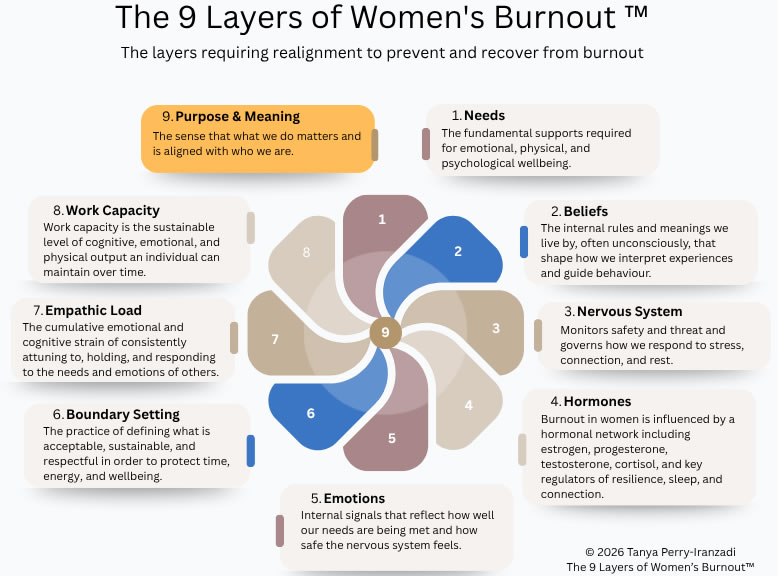
Layer 9: Purpose & Meaning – Why recovery is reconnection & rediscovering our fuel
A woman can be successful, capable, respected and still feel the quiet collapse of meaning underneath it all. She can keep performing, keep delivering, keep leading and keep carrying what others depend on and still find herself asking, often silently:...
Read More