

Over the past four weeks, this series has explored a growing tension emerging inside leadership and work.
We began with burnout not simply as an individual experience, but as a signal that many leadership systems are demanding more human capacity than they are designed to sustain. We then examined the leadership model many organisations inherited: a model shaped around speed, control, endurance, output, and constant acceleration. From there, we explored why many current leadership models are becoming insufficient for environments defined by accelerating complexity, psychosocial risk, technological disruption, and AI-driven change.
And last week, we arrived at a deeper question: As AI expands analytical and operational capability, what forms of human intelligence become more valuable not less?
That question sits at the centre of the Integrated Feminine Leadership Model™.
This model was not developed as a wellbeing framework, a women’s initiative, or an extension of Emotional Intelligence. It emerged from a different observation entirely: Many organisations are attempting to navigate increasing complexity using leadership systems built around too narrow a range of human intelligence.
For decades, leadership environments have heavily legitimised capacities associated with execution, operational control, decisiveness, authority, measurable output, and endurance under pressure. These capacities matter. Direction matters. Authority matters. Delivery matters. Execution matters. But they are not the full range of intelligence required to lead effectively in complex human systems.
As AI increasingly amplifies analytical and operational capability, that gap is becoming more visible. Because leadership is not simply the management of output. Leadership involves the interpretation of complexity. It requires the ability to read systems accurately, regulate pressure intelligently, sustain trust during uncertainty, recognise emerging risk before it becomes visible, navigate ethical consequence, integrate competing realities, maintain meaning during disruption, and make judgements where there is no clear formula available.
These are profoundly human leadership capabilities. Yet many leadership systems have historically granted them lower legitimacy because they are less immediately visible, harder to quantify, and more difficult to reduce to traditional performance metrics.
A Broader Architecture of Human Intelligence
The Integrated Feminine Leadership Model™ was developed in response to that imbalance. At its core, the model proposes that the future of leadership requires a broader architecture of human intelligence than many organisations currently recognise, reward, or systematically develop.
The Six Integrated Leadership Capacities
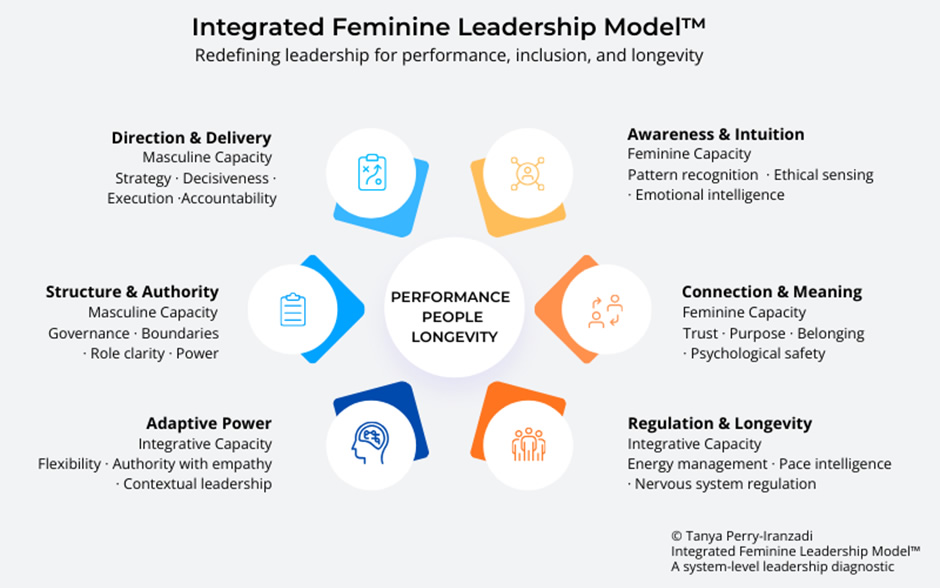
The model integrates six interconnected leadership capacities:
- Direction & Delivery
- Structure & Authority
- Awareness & Intuition
- Connection & Meaning
- Adaptive Power
- Regulation & Longevity
Holding Performance and Sustainability Together
Together, these capacities form a more integrated leadership architecture capable of holding:
- performance and sustainability
- authority and trust
- execution and reflection
- strategic direction and human consequence
- technological capability and human intelligence simultaneously.
Expanding Leadership Rather Than Rejecting It
The model does not reject traditionally valued leadership capacities. It expands them. It argues that leadership systems become unstable when too much emphasis is placed on a narrow band of intelligence while other essential human capacities remain under-recognised, invisibly carried, or structurally unsupported.
The Consequences of an Imbalanced Leadership System
This imbalance has consequences. It contributes to:
- burnout
- weakened trust
- poor truth flow
- reactive leadership
- leadership attrition
- declining adaptive capacity
- performative culture
- and systems that consume human capability faster than they renew it
A Diagnostic and Leadership Redesign Framework
In many organisations, these outcomes are still treated as isolated issues requiring separate interventions. The Integrated Feminine Leadership Model™ proposes something different. It proposes that many of these outcomes are connected symptoms of leadership architecture itself. This is why the model operates as both a leadership diagnostic and a leadership redesign framework. It examines how leadership systems distribute pressure, legitimise authority, reward behaviour, shape relational dynamics, and define sustainable performance over time.
Moving Beyond Extractive Leadership
Importantly, the model does not argue that leadership should become softer, less accountable, or less commercially rigorous. Nor does it argue that masculine capacities are inherently problematic. The issue is not masculinity. The issue is imbalance.
The Issue Is Imbalance, Not Masculinity
Many organisations have become highly developed in forms of intelligence associated with operational acceleration, execution, and extraction, while remaining comparatively underdeveloped in forms of intelligence required to sustain human systems intelligently over time.
Human Leadership in the Age of AI
That imbalance matters more now because the age of AI increases the importance of distinctly human leadership capabilities. AI can amplify analysis, prediction, optimisation, and operational speed.
But it cannot determine:
- what should matter
- what humans can sustainably carry
- how trust is maintained
- how power should be exercised
- how meaning is sustained during disruption
- or what kind of organisational culture is ultimately being created
What Extractive Leadership Consumes
Those remain leadership questions.And they increasingly require a broader range of human intelligence than many inherited leadership models were designed to hold. This is why I describe the model as moving beyond extractive leadership. Extractive leadership is not simply demanding leadership. It is leadership architecture that consumes human capability faster than it renews it. It treats endurance as strength. Overextension as commitment. Acceleration as progress. Depletion is seen as an individual failure to manage pressure well enough and ultimately has no ethical boundaries concerning the consumption of limited resources with little value placed on human career longevity and environmental sustainability.
Designing Leadership for Performance, People and Longevity
The Integrated Feminine Leadership Model™ proposes a different possibility: That leadership systems can be designed to sustain performance, people, and longevity together. That organisations do not need to choose between commercial performance and human sustainability. And that the future advantage may belong not to organisations that extract faster, but to those capable of integrating a broader range of human intelligence into leadership itself.
Over the coming weeks, this series will unpack each of the six leadership capacities in detail and explore what imbalance produces when critical dimensions of human leadership intelligence remain unsupported or underdeveloped.
But before that, there is an important question that must still be addressed.
Why use the term feminine at all?
Why continue naming something that still creates discomfort inside many leadership conversations?
That is where this series now turns next.
Next Article in the Series

Part 6: Why Naming the Feminine Still Matters
One of the most common responses to the Integrated Feminine Leadership Model™ is immediate discomfort with the word feminine. Why use it at all? Why not simply call it an integrated leadership model? Why continue using language many organisations still...
Read More