
One of the most confusing aspects of women’s burnout is this: Many high-performing women can set clear boundaries at work and in the boardroom but struggle to hold them everywhere else. The difference, managing the company resources is one thing managing our own energetic resources is another.
Boundaries are often framed as a personality trait something some people are “good at” and most of us struggle with. But boundaries are not personality, they are a skill and something you can practice and become effective at.
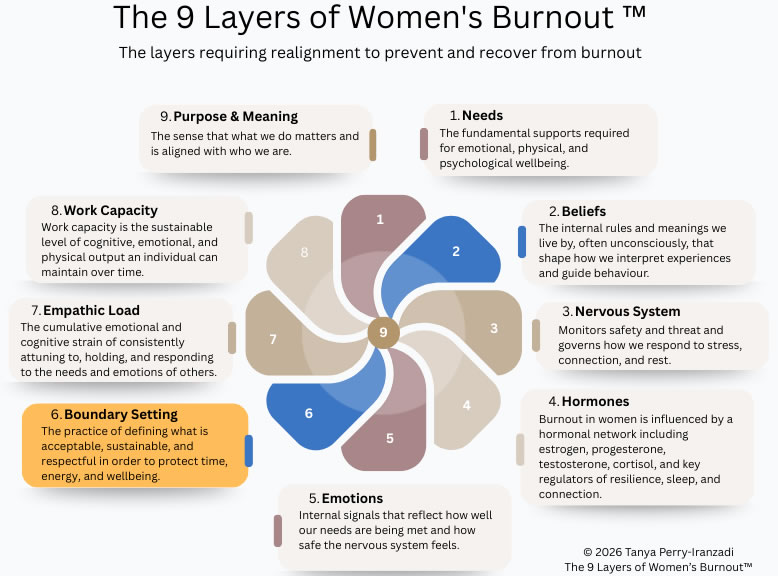
Boundary setting is the practice of defining what is acceptable, sustainable, and respectful in order to protect your time, energy, and wellbeing. When boundaries disappear, burnout accelerates. Not because women lack capability or resilience, but because the flow of demand becomes unlimited and our energy isn’t.
A Story Many Women Recognise
Claire was a senior leader in a large organisation. At work, she was known for being clear, decisive and respected. Her team described her as someone who communicated expectations well and pushed back on unrealistic deadlines.
But outside work, Claire’s life looked very different. Her evenings were filled with managing school logistics, coordinating extended family needs, responding to late-night messages from relatives, organising social obligations, and quietly absorbing emotional tension in her household.
If someone needed help, she stepped in. If something needed organising, she took responsibility. If conflict arose, she smoothed it over. No one asked her to do all of this. But over time, it became the unspoken expectation.
Claire could hold boundaries at work. But in her personal life, she carried the invisible weight of everyone else’s needs. Eventually she began experiencing exhaustion, emotional overwhelm, and the creeping feeling that there was never enough space for herself. Her burnout was not caused by work alone. It was the absence of boundaries across multiple parts of life.
Why Many Women Are Better at Work Boundaries Than Personal Ones
Interestingly, many professional women can set clearer boundaries at work than they do in their personal lives. This isn’t accidental as workplaces provide structural permission and expectations for boundaries: Job descriptions define roles, reporting lines create authority, performance expectations legitimise saying no and professional norms support direct communication. In contrast, personal environments often operate on unspoken expectations.
Women are frequently socialised to be: accommodating, helpful, emotionally available, and responsible for relational harmony. Over time, these expectations become internalised beliefs such as: “It’s easier if I just do it.” “I don’t want to disappoint anyone.” “If I say no, it will create tension.” These beliefs make boundary setting feel uncomfortable even when the demand is unreasonable. The result is that many capable women operate with strong professional boundaries but porous personal ones.
Where Work Boundaries Often Break Down
Even high-performing professionals experience boundary erosion at work. Some of the most common pressure points include:
Availability Boundaries: Always being reachable. Late-night emails. Meetings scheduled across personal time.
Capacity Boundaries: Taking on additional work long after workload has exceeded sustainable limits.
Responsibility Boundaries: Absorbing problems that should sit elsewhere in the system.
Emotional Boundaries: Carrying the stress, conflict, and emotional energy of teams without adequate recovery.
Performance Boundaries: Feeling the need to continually prove value or over-deliver in order to justify your position.
When these patterns persist, women slowly shift from leading their work to absorbing it.
Boundaries Are an Energy Management Skill
In the context of burnout, boundaries are not about being difficult or rigid. They are about regulating the flow of demand into the system. Without boundaries, demand becomes infinite. With boundaries, energy becomes sustainable. Boundaries are therefore less about saying no to others and more about saying yes to capacity, recovery, and longevity.
In the Context of the 9 Layers
Boundary setting does not sit alone. It is shaped by the layers beneath it:
- Needsinfluence whether we recognise our own limits and feel permitted to protect them.
- Beliefsshape the internal rules about responsibility, approval, and disappointing others.
- The nervous systemdetermines whether holding a limit feels safe or like a social threat.
- Hormones and emotions influence our ability to stay regulated in moments of pressure.
When these internal systems are dysregulated, boundary setting becomes far harder. This is why burnout cannot be solved with simple advice like “just set better boundaries.” Boundaries are not a script. They are a capacity built across multiple internal systems.
Why Boundary Setting Can Feel So Difficult
Many women know exactly where a boundary needs to be set. Yet in the moment, they hesitate. We soften the message. We say yes instead of no. We delay the conversation. This is often interpreted as a lack of confidence. But in reality, the nervous system may be responding to something deeper.
For much of human history, women’s social safety depended on maintaining harmony and belonging within their group. Disapproval, conflict, or exclusion could carry real physical risk. As a result, many women are biologically and socially conditioned to monitor the emotional environment closely and avoid actions that might create relational rupture.
Boundary setting can therefore trigger a subtle threat response in the nervous system. The body reads the situation as Conflict may lead to rejection. When that happens, the nervous system often moves into appease or accommodate mode. Women may over-explain, soften their message, or take responsibility for solving the problem themselves.
This is not weakness. It is a protective pattern that once helped maintain safety and belonging. But in modern professional and personal environments, these same patterns can quietly undermine sustainable leadership and wellbeing. Learning to set boundaries therefore involves more than new language. It often requires teaching the nervous system that it is safe to hold a limit.
The Hidden Boundary Problem: Unclaimed Responsibility
One of the least discussed drivers of burnout is responsibility creep. Responsibility slowly expands beyond what was ever formally agreed.
At work this can look like taking ownership of problems that belong elsewhere in the system, absorbing team stress and conflict, compensating for gaps in leadership or resources, and stepping in to prevent things from failing
At home it often appears as becoming the organiser of everyone’s lives, carrying the emotional atmosphere of the household, anticipating needs before anyone asks and smoothing tension so others remain comfortable.
Over time, women are no longer just doing their role. They are holding the system together. This is not simply a workload problem, It is a boundary of responsibility problem. And when responsibility expands without limits, capacity eventually collapses.
The answer is not stopping those functions at home, it is being mindful of their impact on our energy and setting boundaries to support our energy recovery. Any yes it is about setting boundaries with our ‘partners’ to support the needs of the home and family.
Why This Matters in Women’s Leadership
Many high-performing women are promoted precisely because they are capable of seeing what needs to be done and stepping in. But the very skill that makes them effective leaders can also become the mechanism that drives burnout.
Without clear responsibility boundaries, leadership slowly shifts from: influence → to absorption. Women move from leading systems to carrying them.
The Leadership Shift
Healthy boundaries allow women to remain in leadership. Without them, women eventually become the container for everyone else’s pressure. And no human nervous system can sustain that indefinitely.
The future of women’s career longevity will not be determined by resilience alone. It will be determined by whether women feel permitted to protect their capacity.
A Question for Reflection
Where in your life are boundaries clear?
And where have they slowly dissolved?
Often the difference between coping and burning out is not resilience. It is whether the flow of demand has limits.
Layer 6 of the 9 Layers of Women’s Burnout explores how boundary setting protects capacity and why so many women struggle to maintain it despite being highly capable leaders. These patterns, the deeper systems beneath them and the practical skills are explored further in my book:
Burnout is rarely caused by one thing. It is the interaction of multiple layers that quietly shape how women live, work and lead.
Next Article in the Series
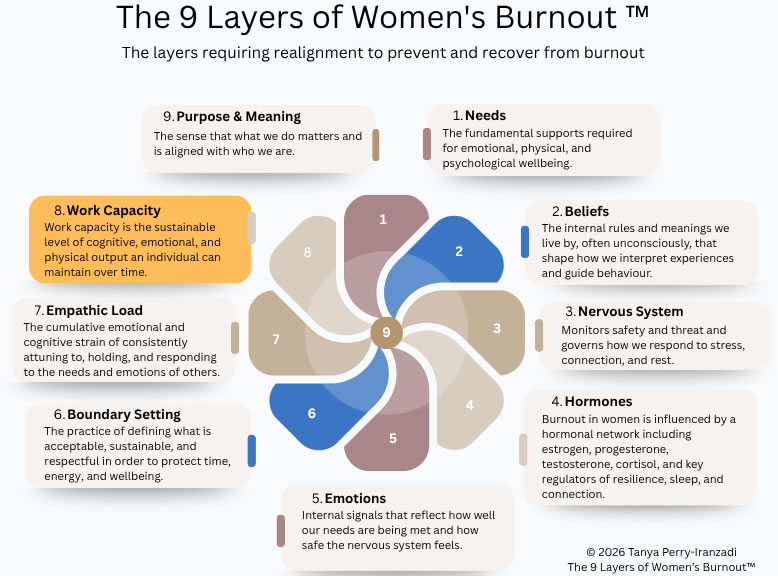
Layer 8: Work Capacity – When Capacity Erosion Becomes a Financial Security Issue
The Career Cost of Ignoring Women’s Work Capacity Across Midlife One of the most expensive mistakes in women’s careers is the belief that work capacity is fixed, endless, or irrelevant so long as performance still looks intact. It is not....
Read More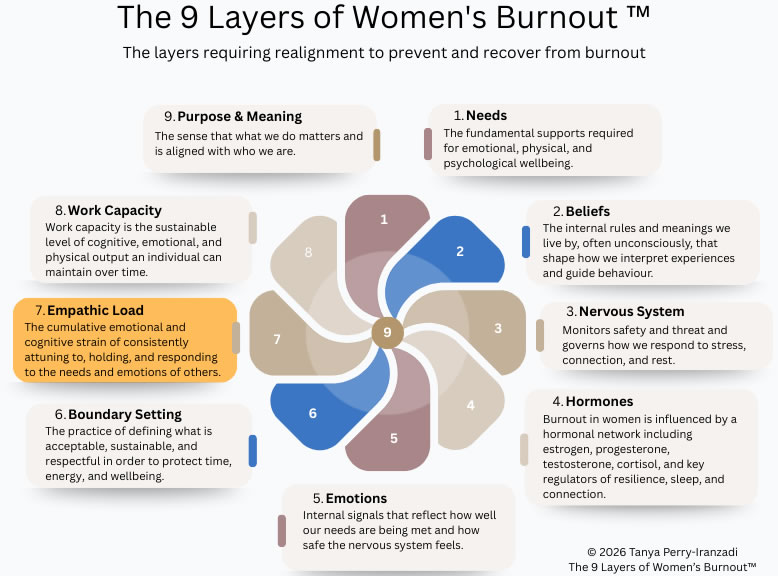
Layer 7: Empathic Load – The invisible cost of empathy
There is a form of work many women perform every day that rarely appears in job descriptions. It is not technical work. It is not strategic work. And it is almost never recognised as labour. It is empathic work. Empathic...
Read More