
Beyond Extractive Leadership

Part 1: Why Burnout Is Also A Leadership System Failure
For years, burnout has been treated primarily as an individual problem. We have encouraged people to build resilience, set better boundaries, recover more effectively, manage energy more consciously, go on leave and return stronger. None of that is irrelevant, but it is no longer...
Read More
Part 2: The Leadership Model We Inherited
Last week, I wrote about burnout as more than a personal experience. Burnout is also a leadership system failure, which raises the next question: What kind of leadership model have we inherited that keeps producing these outcomes at scale? Burnout does not emerge from...
Read More
Part 3: Why Current Leadership Models Are No Longer Enough
Over the past two weeks, I’ve written about burnout not only as a personal experience, but as a leadership system issue, and about the inherited leadership model many organisations continue to operate within. This raises the next question: What happens when the world changes...
Read More
Part 4: At The Crossroads of Intelligence AI v Human
As AI rapidly expands analytical, operational, and predictive capability, organisations are approaching a far more important question than many leadership conversations currently recognise: What forms of human intelligence will become more valuable, not less, in the age of AI? The future of leadership will...
Read More
Part 5: The Integrated Feminine Leadership Model™
Over the past four weeks, this series has explored a growing tension emerging inside leadership and work. We began with burnout not simply as an individual experience, but as a signal that many leadership systems are demanding more human capacity than they are designed...
Read More
Part 6: Why Naming the Feminine Still Matters
One of the most common responses to the Integrated Feminine Leadership Model™ is immediate discomfort with the word feminine. Why use it at all? Why not simply call it an integrated leadership model? Why continue using language many organisations still experience as polarising? These...
Read More
Part 7: Direction & Delivery – The Leadership Capacities we default to as leadership
One of the risks in any conversation about leadership redesign is the assumption that we are arguing against traditional leadership strengths. We are not. The Integrated Feminine Leadership Model™ does not suggest organisations need less direction, less accountability, less execution, or lower performance expectations....
Read More
Part 8: Structure & Authority – The Leadership Capacity That Creates Clarity, Legitimacy, and Coherence
If Direction & Delivery creates movement, Structure & Authority creates the conditions that allow movement to occur coherently. It is the second capacity within the Integrated Feminine Leadership Model™ and sits at the masculine end of the leadership continuum. While Direction & Delivery governs...
Read More
Part 9: Awareness & Intuition The Leadership Capacity That Sees What Metrics Cannot Yet See
If Direction & Delivery creates movement, and Structure & Authority creates coherence, Awareness & Intuition provides something equally essential: It enables leadership systems to sense. It is the third capacity within the Integrated Feminine Leadership Model™ and represents an important shift in the leadership...
Read More
Part 10: Connection & Meaning, The Leadership Capacity That Creates Human Cohesion
If Direction & Delivery establishes strategic direction and momentum, Structure & Authority creates coherence, and Awareness & Intuition enables organisations to sense what is emerging, Connection & Meaning governs something equally fundamental: It creates cohesion. It is the fourth capacity within the Integrated Feminine...
Read More
Part 11: Adaptive Power – The Leadership Capacity That Integrates the Leadership Architecture
Over the past five weeks, this series has introduced four distinct leadership capacities. Direction & Delivery establishes strategic direction and momentum. Structure & Authority creates clarity, governance, boundaries and legitimate authority. Awareness & Intuition enables leaders to perceive what strategy, structure and data cannot...
Read More
Part 12: Regulation & Longevity The Leadership Capacity That Determines Whether Organisations Consume Human Capability or Steward It
Over the past seven weeks this series has progressively revealed the architecture of leadership: Direction & Delivery establishes strategic direction and momentum. Structure & Authority creates coherence through governance, boundaries and legitimate authority. Awareness & Intuition enables leaders to perceive what metrics alone cannot...
Read More
Part 13: Leadership Balance Why Leadership Architecture Matters
Over the past twelve weeks, this series has explored a different way of thinking about leadership. Rather than viewing leadership as a collection of competencies, behaviours or styles, I have proposed that leadership is an architecture. An architecture built upon six essential leadership functions:...
Read More
Part 14: Beyond Extractive Leadership A More Complete Leadership Architecture is Now Required
Last week, I concluded my article by suggesting that leadership is not ultimately measured by what it extracts. It is measured by what it creates. That statement naturally raises an important question. What exactly is extractive leadership? The term is not intended as a...
Read MoreThe 9 Layers of Women’s Burnout
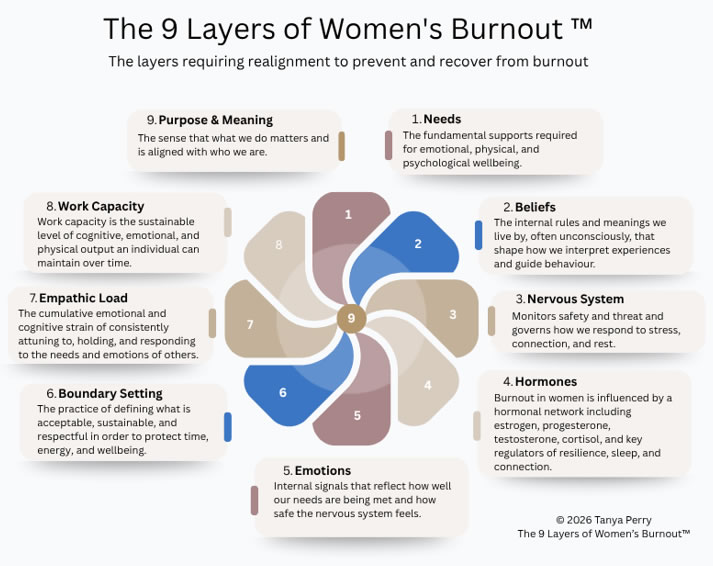
The Anatomy of Women’s Burnout
Introducing the 9 Layers Behind Women’s Burnout For a long time, women’s burnout has been explained as a failure of resilience. Work harder. Rest better. Set boundaries. Practice self-care. And yet, many capable, high-performing women continue to burn out even after they’ve done all...
Read More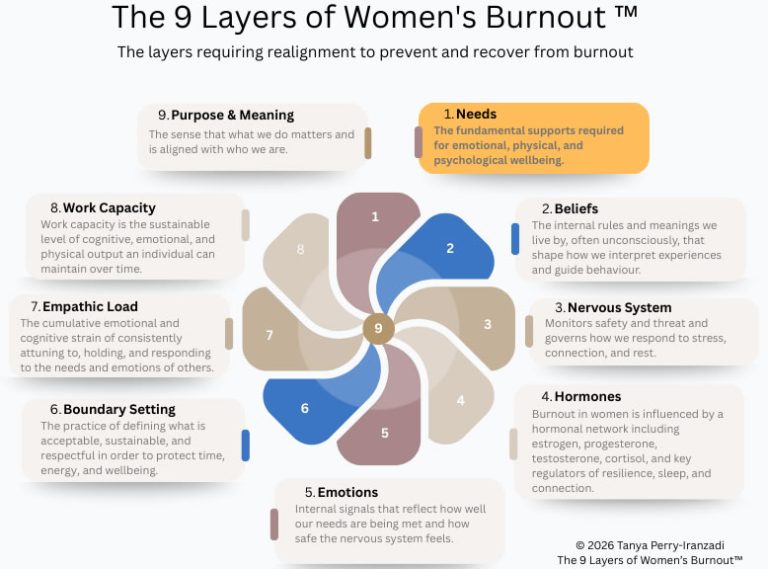
Layer 1: Needs – Where Women’s Burnout Begins
A woman once said to me, quietly: “Nothing is actually wrong… but I’m exhausted all the time.” She was performing well at work, supporting her partner and children and sharing time with friends and family. From the outside, her life looked functional. From the...
Read More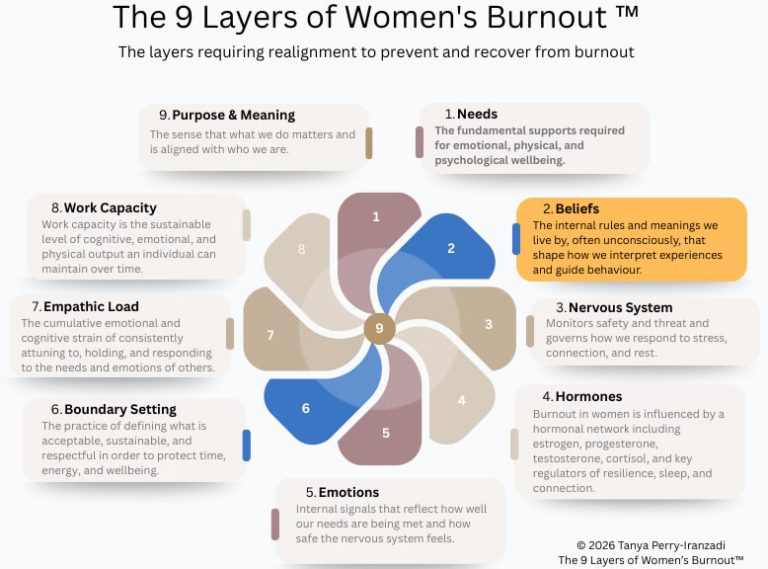
Layer 2: Beliefs – Where Women’s Burnout Is Programmed
Beliefs can either drain your energy or multiply it Most women I work with don’t burn out because they’re unskilled or incapable. They burn out because of the beliefs they’re operating by …unconsciously. Beliefs like: • I have to cope. • Rest has to...
Read More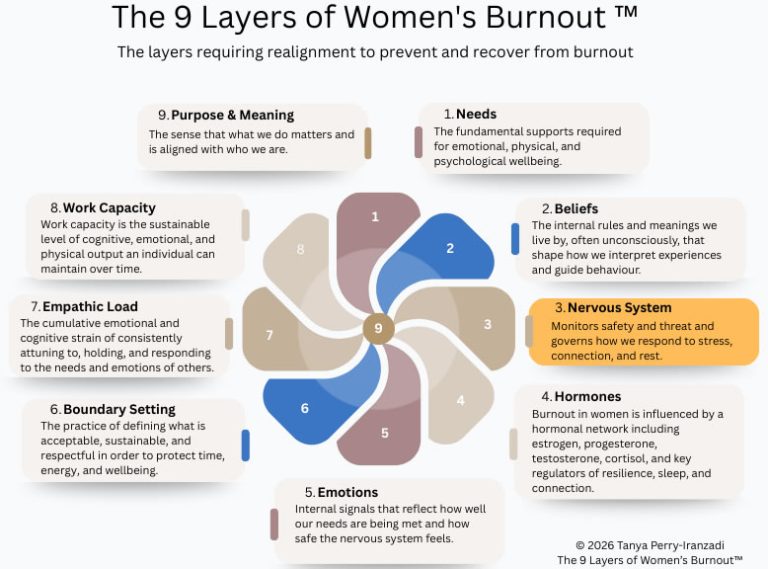
Layer 3: The Nervous System – Where the truth shows up
Layer Three: The Nervous System Burnout doesn’t begin with workload. It begins with a nervous system that has been asked to stay “on” for too long. Not for a day. Not for a quarter. For years. The Woman Who “Can Handle It” Emma is...
Read More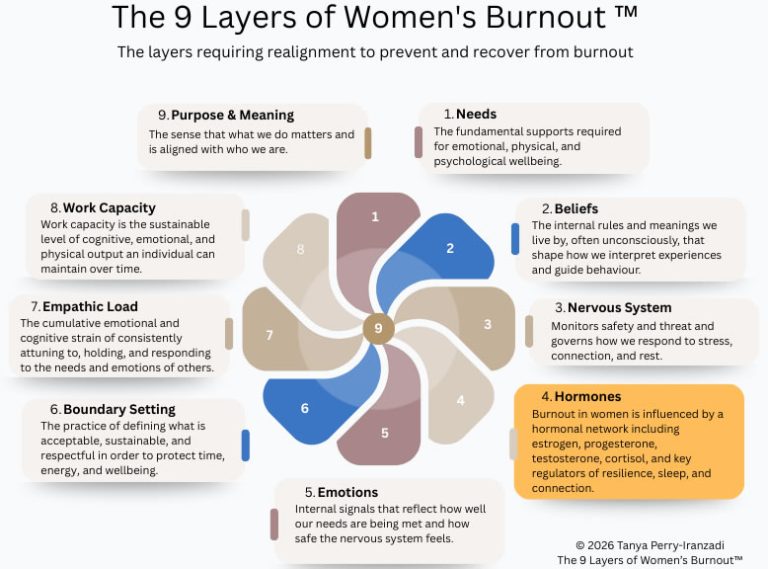
Layer 4: Hormones – The Biology We Were Never Taught to Understand
Burnout in women is not just psychological. It is biological and one of the most misunderstood layers is hormones. Not in the stereotypical “she’s hormonal” sense. But in the reality that hormones regulate energy, cognition, mood, resilience, and recovery. When this layer shifts capacity...
Read More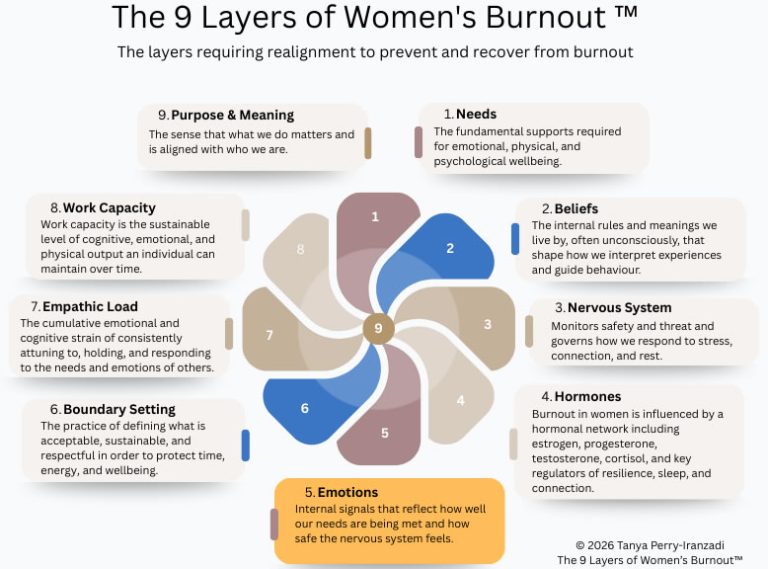
Layer 5: Emotions – The Signals We Were Taught to Ignore
Not as weakness. Not as overreaction. Not as something to “manage better.” But as data. Emotions are internal signals. They reflect how well our needs are being met and how safe our nervous system feels. Burnout does not begin with exhaustion. It begins when...
Read More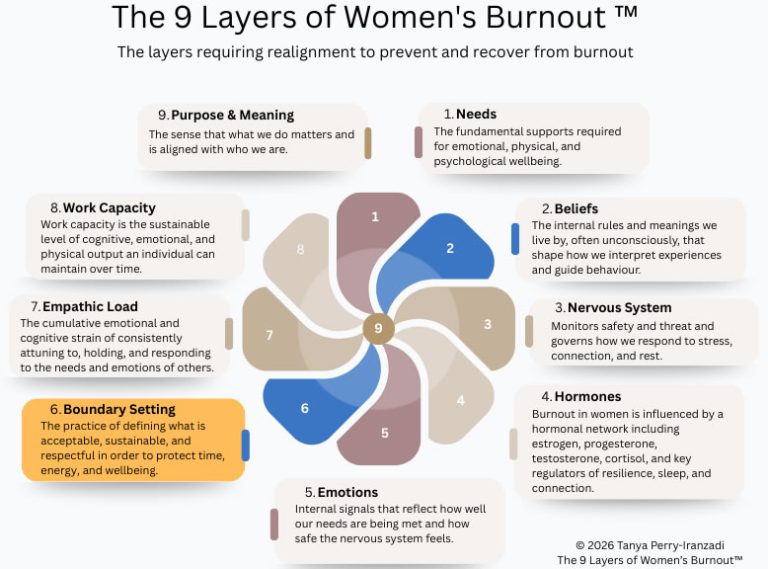
Layer 6: Boundary Setting – Protecting time, energy, and sustainable capacity
One of the most confusing aspects of women’s burnout is this: Many high-performing women can set clear boundaries at work and in the boardroom but struggle to hold them everywhere else. The difference, managing the company resources is one thing managing our own energetic...
Read More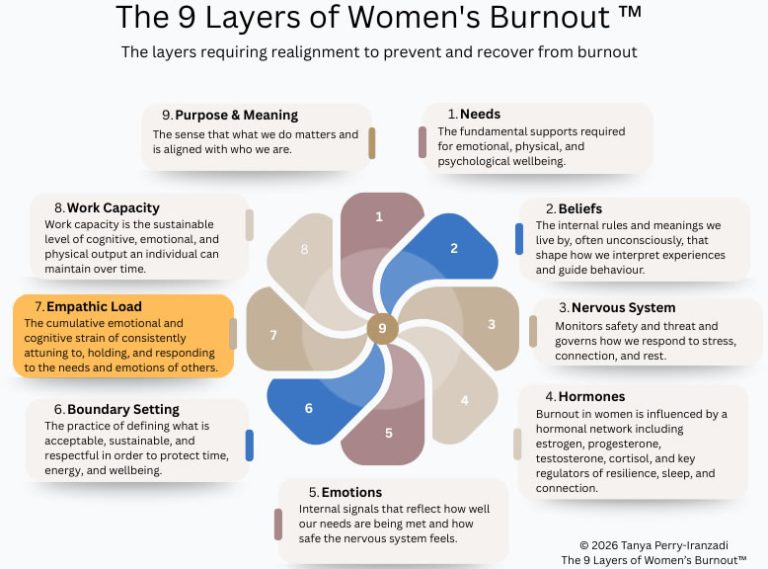
Layer 7: Empathic Load – The invisible cost of empathy
There is a form of work many women perform every day that rarely appears in job descriptions. It is not technical work. It is not strategic work. And it is almost never recognised as labour. It is empathic work. Empathic load is the cumulative...
Read More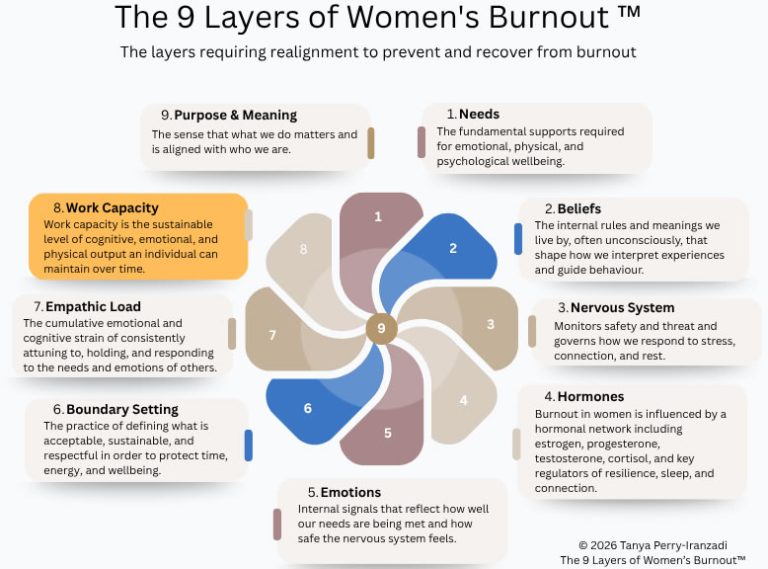
Layer 8: Work Capacity – When Capacity Erosion Becomes a Financial Security Issue
The Career Cost of Ignoring Women’s Work Capacity Across Midlife One of the most expensive mistakes in women’s careers is the belief that work capacity is fixed, endless, or irrelevant so long as performance still looks intact. It is not. For many women, the...
Read More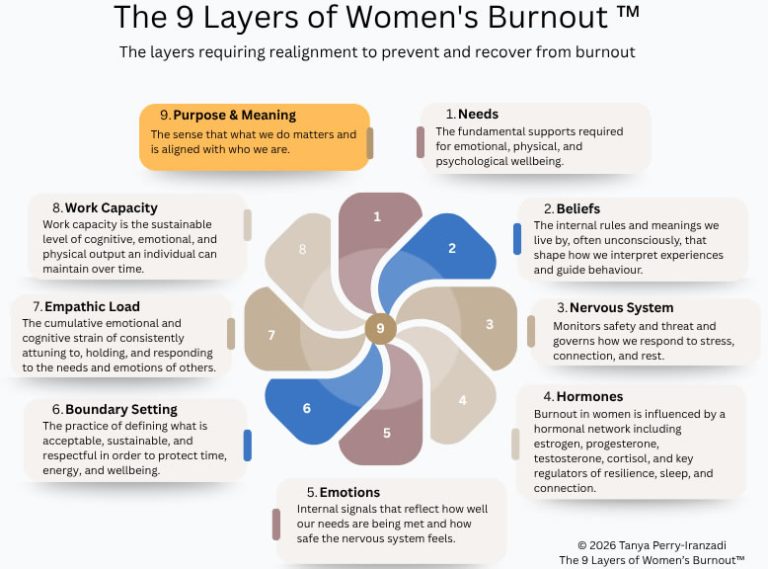
Layer 9: Purpose & Meaning – Why recovery is reconnection & rediscovering our fuel
A woman can be successful, capable, respected and still feel the quiet collapse of meaning underneath it all. She can keep performing, keep delivering, keep leading and keep carrying what others depend on and still find herself asking, often silently: What is the point...
Read MoreThe Burnout Generations

How Women Can Rise Again After Burnout
When burnout disguises itself as choice For many women, burnout doesn’t arrive as collapse. It arrives as rational decision-making. “I’ll take something with less responsibility.” “I don’t need that level of pressure anymore.” “Maybe leadership just isn’t for me.” But beneath those decisions is...
Read More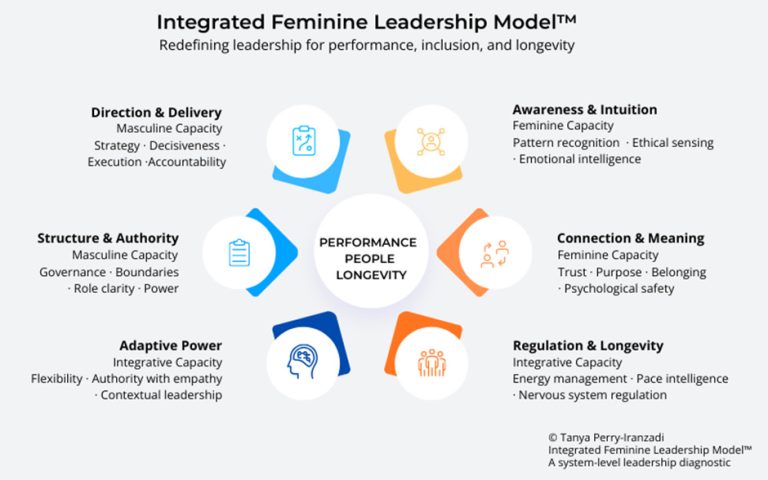
Launch of the Integrated Feminine Leadership Model
Burnout Is Not a Personal Failure. It Is a Leadership System Design Issue. For years, organisations have responded to burnout, particularly among senior women, with resilience training, wellbeing initiatives, and advice to “set better boundaries”. And yet the same patterns persist: high-performing women exiting leadership...
Read More
The Career-Sabotaging Beliefs Two Generations of Women Inherited
For two generations Gen X and Gen Y women were raised on a powerful cultural promise: “You can be anything, do anything, and have it all.” It was energising. Empowering. Revolutionary. But there was a catch we did not see coming. At the very...
Read More
Women Changing The Corporate System From Within
The corporate system was not designed with women in mind. This isn’t an opinion. It’s history. Modern organisational structures were built during a time when leadership assumed: a full-time, uninterrupted career a worker with no primary caregiving responsibility emotional neutrality as professionalism stamina over...
Read More
Women in Leadership Burnout: Why Gen X & Gen Y Were Set Up to Fail
When I look at this image, I see more than three women. I see three eras of expectation, each generation lifting the next, each inheriting a set of rules they never wrote. The silent battles. The invisible load. The resilience that was required long...
Read More
The Future of Women at Work Must Be Designed
When You Get in Touch, You Can Expect:
A focused conversation about your organisation’s priorities
Clear options for workshops, keynotes, programs or consulting
Guidance on the most relevant consulting, program or workshop pathway